Engineer News Network The ultimate online news and information resource for today’s engineer
An RFID system in which PCBs communicate with their SMT production line and contain all the relevant manufacturing data has been developed by Harting.
Based on the company’s RFID-4-SMT auto-ID solution, the new system cuts error rates, radically simplifies documentation requirements and forms the basis for automated PCB production in a batch size of 1.
When the PCB is first produced, a small UHF RFID chip is inserted in the blank or attached as a component later on.
From this point, manufacturing data can be written to and read from the RFID chip at each station in the manufacturing process. Even unplanned events such as machine malfunctions can be stored.
This is all enabled by the cutting-edge UHF RFID technology from HARTING. Thanks to the coaxial-cable-based Ha-VIS LOCFIELD antenna and the Ha-VIS RF-R350 flexible UHF RFID reader based on Harting’s MICA industrial computing platform, realisation involves a minimum of effort.
The antenna field follows a coaxial conductor and allows communication with several PCBs in a single PCB panel at full manufacturing speed.
The reader and antenna can easily be integrated into both new and old systems. The compact design and IP67 protection class also facilitate upgrading.
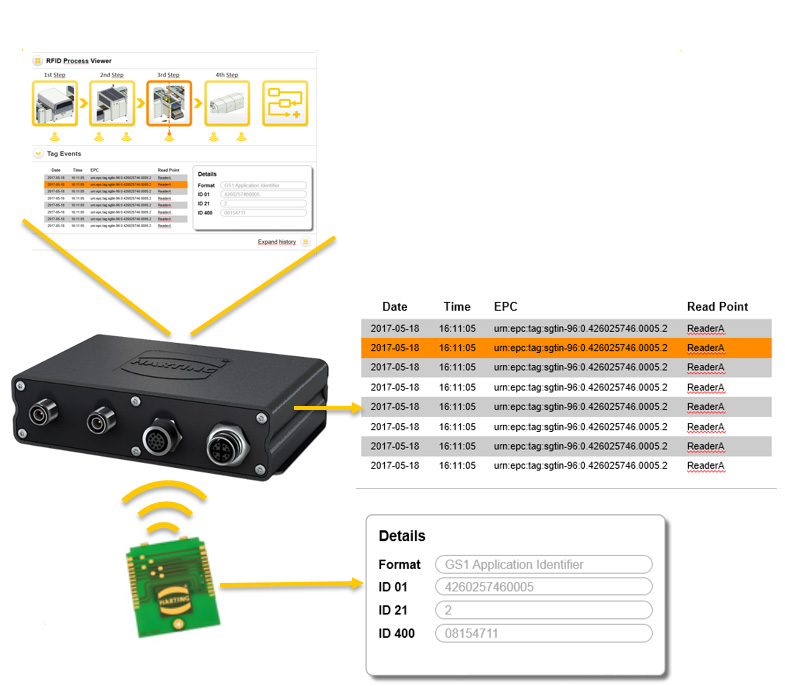
Full data integration in the manufacturing system is therefore made possible – but not absolutely necessary – at any time.
Thanks to the modular and open software architecture of the Ha-VIS RF-R350 UHF RFID read-write device, the data can be pre-processed in the reader.
The data is stored in line with ISO standards and the GS1 standards applied to commercial goods transport. This applies not only for the ID of the PCB itself, but also for the processing and manufacturing data stored in the user memory of the RFID chip. This data is all transparent and can thus easily be used later by a third party.
Using the ID characteristics of the PCB throughout the production lifecycle
Once the UHF RFID technology has been fitted on the PCB, it can be used throughout the lifetime of the PCB. It is possible for several PCBs to be read in bulk without optical contact: for example, through foil and cardboard packaging, which makes the technology eminently suitable for warehouse and logistics processes.
In addition, the information can also be read when the PCB is already installed in the application.
Provided that the housing does not consist entirely of metal and certain basic physical principles are adhered to, the information on the RFID chip can continue to be used and updated.
The options offered by the UHF RFID technology remain available until the PCB is disposed of, and can enable and improve a range of different applications.